
The scale is no longer ambiguous. Nationally, 595,660 people were recorded as victims of theft in 2024 — the highest figure in 21 years, and a 6% increase on the year before. Retail premises now account for close to half of all recorded theft incidents in Australia, up sharply from a decade ago. The cost to the retail sector alone is estimated at A$7.79 billion for the 2023–24 financial year — a figure that has grown by roughly 40% in just two years.
This isn’t a story about one bad year. It’s a structural shift in where crime in Australia is concentrated, and it’s happening at a scale that touches almost every retailer, centre manager, and commercial property operator in the country.
Every business owner reading these numbers is asking some version of the same question: what do we actually do about it? And increasingly, the answer being offered — by security vendors, by industry commentary, by AI surveillance providers — is some version of “upgrade your camera system.”
That’s not wrong. But it’s incomplete, and it skips over an important distinction most retailers aren’t hearing enough about: not all theft looks the same, and the right response depends on which kind you’re actually dealing with.
The Scale of the Problem
A few figures are worth sitting with before jumping to solutions.
Retail locations accounted for 31.6% of recorded theft incidents in 2010. By 2024, that figure had risen to 45.1% — meaning almost half of all recorded theft in Australia, excluding motor vehicle theft, is now connected to retail premises. Over the same period, residential theft fell as a share of the total, suggesting this isn’t simply “more crime everywhere.” It’s a specific concentration of theft activity into retail environments.
The financial toll matches the incident data. The 2024 ANZ Retail Crime Study, led by Griffith University, put the cost of retail crime to the Australian sector at approximately A$7.79 billion in the 2023–24 financial year — a cost that has grown by around 40% in just two years.
In New South Wales, the trend is sharper still. Theft from retail stores rose 9.3% over the two years to December 2025, according to ABS data, with Greater Sydney recording an even steeper 13.5% increase over the same window. The most commonly shoplifted item in NSW throughout 2025 was liquor — a detail that matters operationally, since it points to specific store zones and product categories carrying disproportionate risk.
What none of these figures tell you on their own — and what most commentary discussing them stops short of addressing — is what a retailer or centre manager should actually do with this information beyond “invest in security.”

Not All Theft Looks the Same: Understanding Organised Retail Crime
One distinction that gets lost in most headline coverage of the retail theft data: a meaningful and growing share of it isn’t opportunistic. It’s organised.
Organised retail crime — coordinated groups working together to steal merchandise at scale, often for resale — behaves differently to individual shoplifting, and it requires a different security response. Industry reporting increasingly describes tactics like “swarming,” where multiple people enter a store simultaneously to overwhelm staff attention and conceal large volumes of stock in a short window — a fundamentally different scenario to a single person concealing an item.
This distinction matters practically. A security setup designed around single-person shoplifting — one camera angle, one staff member trained to watch for concealment behaviour — is poorly equipped to handle a coordinated group entering with a rehearsed plan. Detecting and responding to organised retail crime typically requires broader camera coverage, faster alerting across multiple zones simultaneously, and a staff response protocol built around de-escalation and documentation rather than individual confrontation.
For retailers evaluating their security posture, the first useful question isn’t “do we need better cameras.” It’s “what proportion of our loss is opportunistic versus organised, and does our current setup actually distinguish between the two?”
The Advice Gap: “Get AI Surveillance” Isn’t a Strategy
iCetana.ai and other AI surveillance providers have recently published commentary making the case that traditional CCTV is no longer sufficient — that recording activity after the fact doesn’t stop it from happening while it’s underway.
That’s a fair and increasingly well-supported point. Recording and monitoring are genuinely different capabilities, and a growing body of evidence supports the idea that real-time detection and alerting changes security outcomes in ways that passive recording cannot.
But “you need AI surveillance” is where most of this commentary stops — and where the genuinely useful advice should start. Because the honest next question is: what does that actually require, what does it cost, and how do you know if it’s working for your specific site, against your specific mix of opportunistic and organised threats?
This is the gap Alphalogix sits in. We don’t build AI surveillance platforms. We evaluate, deploy, and integrate them — which means our incentive is getting the deployment right for your site, not selling you a specific product.
Questions worth asking before any AI surveillance investment
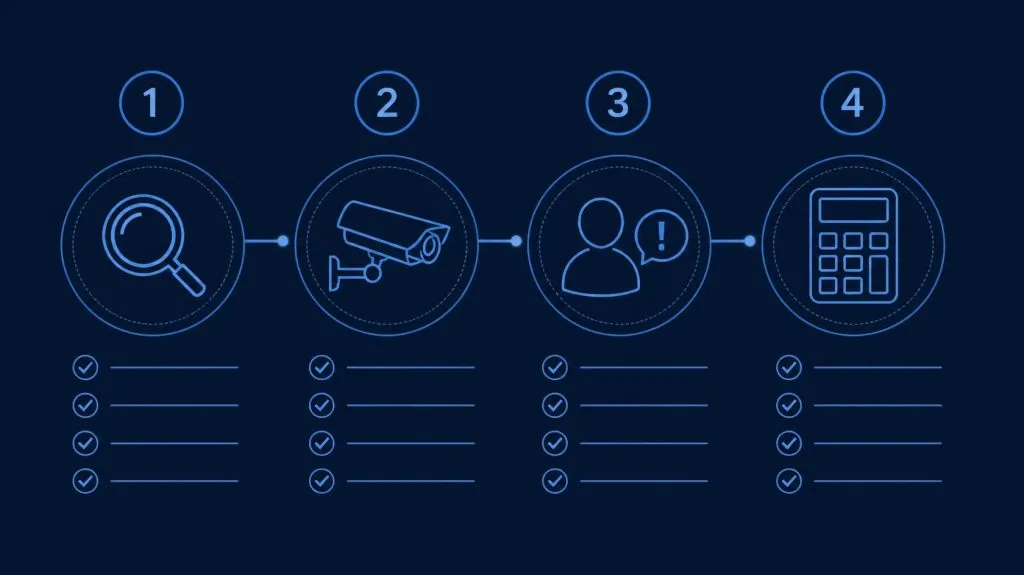
If you’re a retailer or property manager evaluating this decision, here’s the framework we’d walk through before recommending anything:
What’s your actual loss pattern? Liquor theft in a supermarket requires a different camera and alert configuration than jewellery theft in a specialty store, which requires something different again from organised retail crime targeting multiple locations. Generic AI surveillance marketing rarely addresses this — the right configuration depends entirely on what and where you’re actually losing stock.
What’s your existing camera infrastructure capable of? Many sites already have adequate camera hardware and simply lack the software layer, network configuration, or monitoring workflow to use it effectively. Understanding what you already have avoids paying for hardware you don’t need.
Who receives the alerts, and what happens next? An AI system generating alerts that nobody is positioned to act on produces no operational benefit regardless of how sophisticated the detection technology is. This is a staffing and process question as much as a technology question.
What’s the realistic cost-benefit for your scale? A single-site independent retailer has a fundamentally different calculation than a multi-site shopping centre group. Solutions that make sense at one scale can be poor value at another.
What the Statistics Mean for Different Retail Environments
The rising theft data doesn’t affect every type of retail site equally, and the right response differs by environment.
Standalone retail stores are typically most exposed to opportunistic theft and staff safety incidents during direct confrontation. For these sites, camera placement, clear identification footage at entry and exit points, and integration with point-of-sale exception reporting often deliver more practical value than a full AI analytics deployment.
Shopping centres and multi-tenant retail precincts face a more complex picture — theft occurring across common areas, individual tenancies, and car parks, often requiring coordination between centre management and individual retailers who may each have separate security arrangements. This is where AI-powered analytics across a shared camera network can genuinely change the equation, provided the alert and response workflow is built to match that complexity.
High-value specialty retailers — jewellery, electronics, designer goods — face lower incident frequency but substantially higher losses per incident, often involving organised groups rather than opportunistic individuals. The security response here typically needs to be weighted toward prevention and deterrence rather than post-incident detection alone.
Understanding which category your business falls into is the first real step — well before evaluating specific technology platforms.

See More. Respond Faster. Stay Secure.
If you’re reviewing your security setup in light of the current retail theft data — whether you’re a single store, a multi-site retailer, or a shopping centre operator — we start with an honest assessment of your specific environment, not a product recommendation.
No obligation, no lock-in, honest advice.
Statistics referenced from the Australian Bureau of Statistics, the Australian Retailers Association, the 2024 ANZ Retail Crime Study (Griffith University), and NSW BOCSAR data as reported by Security Wholesalers.
Alphalogix is a Sydney-based managed IT company.